
Governing LLMs in a Bank When Model Risk Guidance Is Silent
The 2026 US interagency model risk guidance (SR 26-2) states that generative AI and agentic AI models are “novel and rapidly evolving” and are “not within the scope of this guidance”. The same footnote adds that a banking organisation’s own risk management and governance practices should guide controls for anything the document does not cover. The OCC’s bulletin says the agencies plan to issue a request for information on banks’ use of AI, but today the written US standard is thin.
Meanwhile the Financial Stability Board’s October 2026 report on sound AI practices does cover generative and agentic AI, and the EU AI Act became applicable on 2 August 2026, with some obligations phased in later. In our view, a bank that waits for a US rule is making a choice, and not a safe one.
Why LLMs are hard to validate
A credit scorecard gives the same output for the same input, and its inputs and logic can be inspected. A large language model can give different outputs to the same prompt, depends on training data the bank did not choose, and may change when the vendor updates it. Classic checks such as back-testing against outcomes fit awkwardly.
A practical control framework
This is our suggestion, built on the principles that already exist for models. Figure 1 shows the seven controls in sequence, and the list below explains each one.
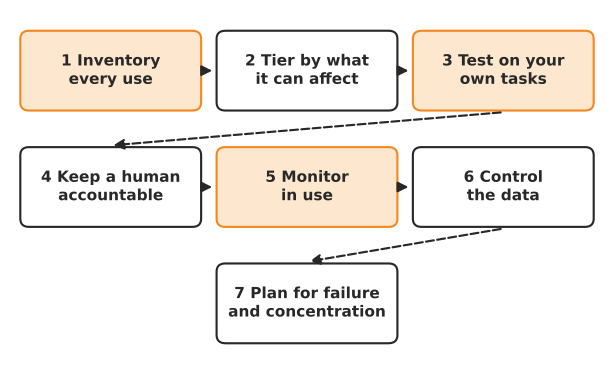
Figure 1. The seven controls. Illustration.
- Inventory every use. Record each LLM application, its owner, its vendor and model version, and the decisions it influences. Include tools staff adopted themselves.
- Tier by what it can affect. A tool that drafts internal meeting notes is not the same as one that summarises a loan file for an underwriter or answers customers.
- Test on your own tasks. Build a fixed evaluation set from real, representative cases and score it before use and after every model or prompt change. Record accuracy, failure types and unsafe outputs.
- Keep a human accountable. For anything that touches a customer or a credit decision, a named person must review and own the result.
- Monitor in use. Sample outputs, track complaint and error rates, and watch for drift when the vendor updates the model.
- Control the data. Decide what may be sent to a vendor, and check contracts for retention and training use.
- Plan for failure and concentration. Know what happens if the vendor changes terms, degrades, or is unavailable.
Tiering in practice
Tiering is the control that decides how hard the others work. Two questions drive it: what the output can affect, and how much a human reviews it before it has an effect. The FSB report makes a similar link. Its practice 5 asks institutions to assess the materiality and risk of AI use cases at inception and thereafter, and its practice 10 asks for human oversight relevant to materiality, risk, autonomy, complexity and explainability.
Figure 2 combines the two questions into a simple grid. The labels are ours and are meant as a starting point for your own tiering rule, not a standard.
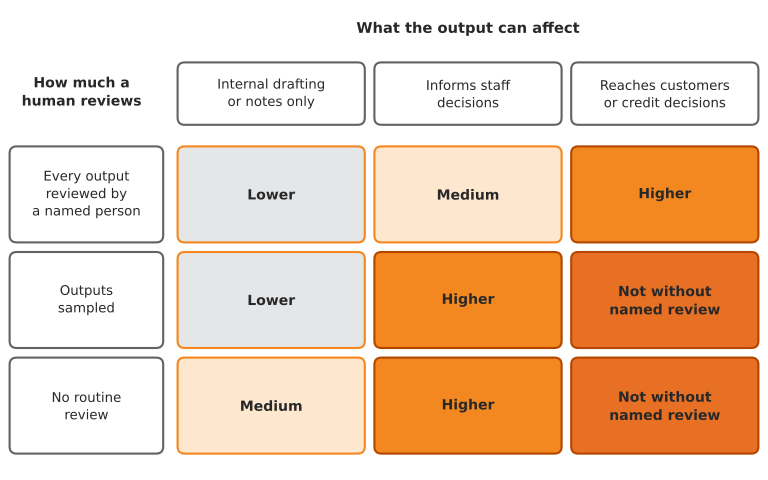
Figure 2. A risk-tiering matrix for LLM use cases. Lower, Medium and Higher are tiers of control effort; “Not without named review” follows from control 4. Our interpretation.
The matrix also shows why inventory comes first. A tool staff adopted themselves will not appear in any tier until someone records it.
From idea to deployment
The controls become a routine once they are put in order. Figure 3 follows a new use case from the first record in the inventory to deployment and, importantly, back to testing whenever the model, the prompt or the vendor’s version changes. That last step is what separates an LLM from a scorecard: the thing you tested can change without your involvement.
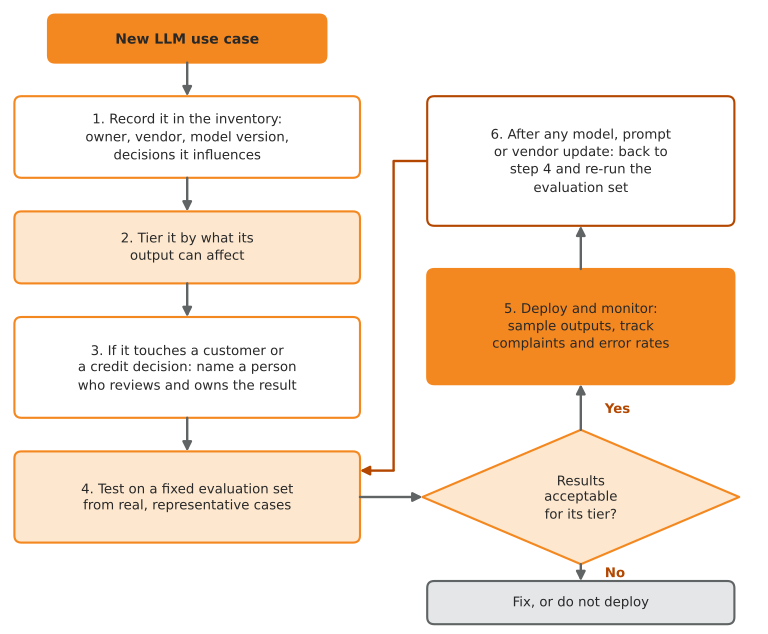
Figure 3. A decision flow for taking an LLM use case from idea to deployment. Our interpretation.
Who owns what
Controls only work if someone owns them. The FSB’s practices 1 and 2 call for board and senior management oversight and for clear roles and accountability. Figure 4 stacks the layers we would expect in a bank and shows the three moments at which checks fall: before use, in use and on change.
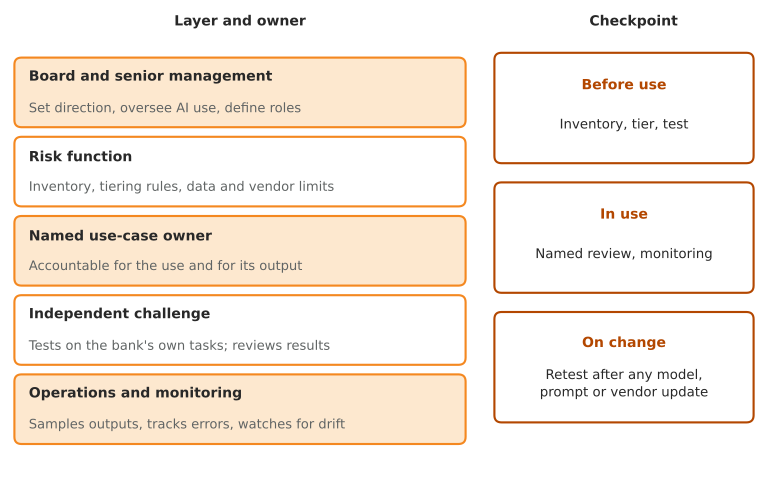
Figure 4. Governance layers and checkpoints for LLM use. Our interpretation.
Keep what works
None of this requires a new discipline. Inventory, materiality, independent challenge and monitoring are the same ideas as for conventional models, applied to a system whose behaviour is less predictable. Institutions that already run these processes well can extend them. Those that do not have an extra reason to start.
Sources
- Federal Reserve, Supervisory Guidance on Model Risk Management (footnote on generative and agentic AI)
- OCC Bulletin 2026-13
- FSB, Sound Practices for Responsible Adoption of AI, 15 October 2026
- FSB, Final report (PDF)
- European Commission, AI Act regulatory framework
Checked on 24 November 2026. General information, not legal advice.