
Adverse Action, Explainability and Fair Lending in Credit Models: What Is Current
Lenders that use statistical or machine learning models must still tell declined applicants why. They also need to know whether their models treat groups of applicants fairly. Both areas moved in 2025 and 2026: the CFPB withdrew circulars on adverse action and complex algorithms, and amended Regulation B to remove the “effects test”. This article sets out what the rules say now, with the regulator text and our interpretation kept apart, and shows how a team can test a model for both explainability and fairness.
What Regulation B requires now
Regulation B (12 CFR part 1002), as shown on the CFPB’s site, requires a creditor to give notice of action taken within 30 days after receiving a completed application. A notice of adverse action must be in writing and contain either a statement of specific reasons for the action taken, or a disclosure of the applicant’s right to a statement of specific reasons (requested within 60 days). Section 1002.9(b)(2) says the statement must be specific and indicate the principal reason or reasons for the adverse action.
The same paragraph adds that statements that the adverse action was based on the creditor’s internal standards or policies, or that the applicant failed to achieve a qualifying score on the creditor’s credit scoring system, are insufficient. The official commentary says a creditor must disclose the principal reasons, and that the regulation sets no fixed number but disclosing more than four is not likely to be helpful.
The commentary to the definition of credit scoring systems also says a system must be revalidated frequently enough to continue meeting recognised professional statistical standards. It gives examples of reviewing delinquency rates by score interval and analysing population stability. We read this text as reproduced in the CFPB’s April 2026 rule document, where it appears as existing commentary.
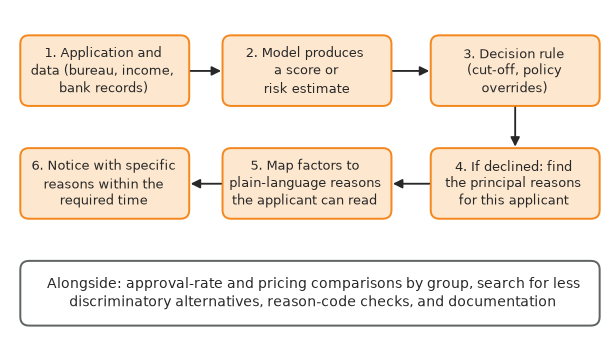
Figure 1. Where explainability and fairness checks sit in a lending decision flow. Illustration.
What was withdrawn
The CFPB’s Withdrawn Guidance page lists Consumer Financial Protection Circular 2022-03 (adverse action notification requirements in connection with credit decisions based on complex algorithms) and Circular 2023-03 (adverse action notification requirements and proper use of sample forms). Both are shown as withdrawn on 12 May 2025. The same page lists the 2021 Special Purpose Credit Programs guidance (86 FR 3762) as withdrawn on 17 June 2026. We found no entries on that page about artificial intelligence or disparate impact.
Interpretation: withdrawal removes those circulars as statements of the Bureau’s position. It does not change the regulation. The notice duty, the 30-day timing and the specific reasons standard are in the rule text above, and nothing we read repeals them. A conservative reading is that a notice listing reasons that do not reflect what actually drove the decision remains a compliance risk, whether or not a circular says so.
What changed on disparate impact
The CFPB issued a final rule on 22 April 2026 amending Regulation B on disparate impact, discouragement and special purpose credit programs. Per the rule text the effective date is 90 days after Federal Register publication, which the CFPB’s Regulation B page reflects as 21 July 2026. The Bureau removed the “effects test” from the regulation and stated that ECOA does not recognise disparate-impact liability. In the rule’s amended commentary, new comment 6(a)-2 says the Act “does not provide for the prohibition of practices that are facially neutral as to prohibited bases, except to the extent that facially neutral criteria function as proxies for protected characteristics designed or applied with the intention of advantaging or disadvantaging individuals based on protected characteristics”. It also deletes the effects test language from the commentary on credit scoring systems.
The rule took effect on 21 July 2026 but is being challenged in federal court (National Fair Housing Alliance v. CFPB, D.D.C., filed May 2026; a second suit was filed in the District of Massachusetts in October 2026). The plaintiffs ask the courts to vacate it. If they succeed, the earlier Regulation B text, including the effects test, could be restored. Check the status before relying on the rule. This litigation information comes from law-firm and specialist news reports (secondary sources), not from court documents we read.
The Bureau’s response to commenters is worth reading. Some commenters said disparate-impact liability is particularly important in certain areas, including automated credit models (specifically AI-driven models). The Bureau replied that ECOA still protects against intentional discrimination, that facially neutral policies may still violate the law if they are proxies or pretexts for discrimination on a prohibited basis, and that disparate-impact liability may increase burdens on AI developers and users.
Interpretation: the federal rule narrows what the CFPB will treat as a violation. It does not make disparate outcomes irrelevant. Intentional use of a proxy is still prohibited. Law-firm commentary we read (secondary, please verify with counsel) points out that courts, not the Bureau, decide what the statute means, that private plaintiffs may still argue disparate impact, and that some states, for example New York, whose Department of Financial Services issued an industry letter on 22 April 2026, continue to treat disparate impact in credit as potentially unlawful. For mortgage lending, the Fair Housing Act is a separate source of disparate-impact exposure, and HUD’s proposal to remove its own disparate-impact rule had not been finalised at the time of writing. Many institutions therefore keep testing outcomes, because the legal position outside the Bureau’s rule is not settled and because proxy risk is hard to assess without measuring outcomes.
Illustrative example with synthetic data
We simulated 30,000 applicants (Python, fixed seed) with five inputs: card utilisation, past delinquencies, credit history length, debt-to-income and recent inquiries. A synthetic “Group B” (30.2% of applicants) is not an input to the model but has, on average, higher utilisation and a shorter history. These labels are artificial. We fitted a logistic regression and approved the 70% of applicants with the lowest predicted default probability. The default rate was 12.0% and the model’s AUC (a measure of ranking power) was 0.696.
Reasons. For one declined applicant whose predicted default probability (14.07%) sat just above the cut-off (14.03%), we measured each input’s effect on the log-odds of default against the average approved applicant. Debt-to-income (+0.65), past delinquencies (+0.41), card utilisation (+0.37) and recent inquiries (+0.07) pushed towards decline, while credit history length (-0.74) helped. The principal reasons are the first three, not all five factors, and the long credit history is not a reason for decline.
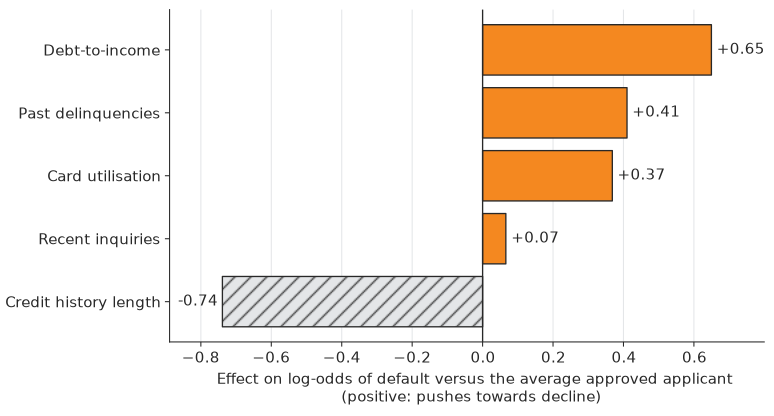
Figure 2. How reasons can be derived from a model for one declined applicant. Synthetic data.
Outcomes. Approval rates were 75.2% for Group A and 58.0% for Group B, a ratio of 0.77, even though the group is not a model input. (The “80%” or four-fifths figure some readers know comes from employment-selection guidance, not ECOA or Regulation B; no ratio is a legal safe harbour or violation threshold for credit.) Among approved applicants the default rate was 7.6% for Group A and 8.6% for Group B. We then refitted the model without each input in turn. Dropping credit history length lifts the ratio to 0.85 (approval 73.4% against 62.1%) and lowers AUC to 0.674, a cost of 0.022. Dropping debt-to-income does the opposite: the ratio falls to 0.74. Dropping recent inquiries barely changes either measure (AUC 0.693, ratio 0.79).
This is the kind of table a team would use for a less discriminatory alternative search: each candidate’s predictive cost against its effect on outcomes. That analysis comes from the disparate-impact framework, which the CFPB no longer applies under ECOA but which may still matter under state law, the Fair Housing Act, private litigation, or if the rule is vacated. Whether a candidate is acceptable is a business and legal decision, not a statistical one. The ratio is a monitoring metric in this example, not a legal threshold.
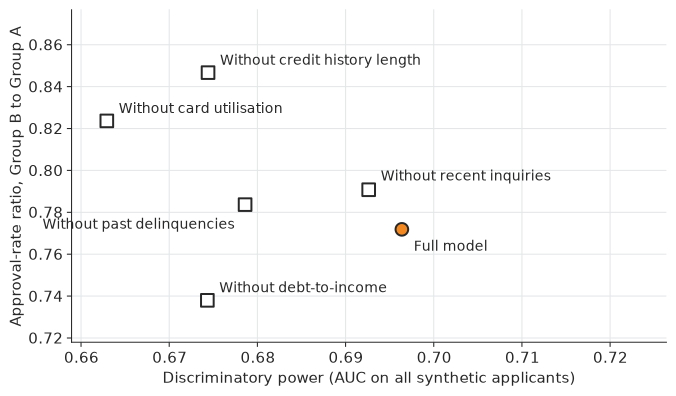
Figure 3. Predictive power against the approval-rate ratio for candidate models. Synthetic data.
What goes wrong
These are interpretations, not regulator text.
- Reasons that do not match the model. A generic list of reasons mapped to the first few features, rather than the factors that drove this decision.
- Opaque inputs. Variables that are hard to translate into a reason a person can understand make accurate notices difficult.
- Ignoring proxies. A variable can correlate strongly with a protected characteristic and still look neutral. Checking only the model’s formal inputs misses that.
- Testing once. Population drift changes both accuracy and outcomes. Revalidation and monitoring should include the group comparisons.
- Treating a regulatory change as a reason to stop looking. The 2026 rule narrows one federal theory. It does not remove disparate treatment risk, state law, or the reputational cost of unexplained outcomes.
- Weak model governance. The interagency model risk guidance issued as the Federal Reserve’s SR 26-2 (April 2026, with the OCC and FDIC) takes a risk-based approach to model risk management tailored to a banking organisation’s model risk profile. For the banking organisations it covers, adverse action and fairness testing belong in the model’s validation and monitoring plan.
An illustrative project
This is an anonymised, synthetic scenario, not real client work. A consumer lender is replacing a scorecard with a gradient-boosted model. The team begins by writing down how each model factor will be translated into a reason a person can understand, and tests the reasons on a sample of declined applications. It then compares approval rates, pricing and default rates by group on historical data, runs the alternative search shown above, and takes the results to a committee that includes compliance and legal. The decision, the alternatives considered and the reasons for the choice are recorded in the model file.
How to start
- Map every model input to a plain-language reason, and test the reason logic on real declines.
- Check your notices against section 1002.9 and its commentary (including the ECOA notice and agency details), and against the Fair Credit Reporting Act’s adverse action and credit-score disclosure rules where a consumer report was used, not against withdrawn circulars.
- Build a standing monitoring report: approval rates, pricing, reason frequencies, and drift.
- Agree with counsel how you will treat disparate impact under federal and state law, and write down the decision.
- Add the checks to your model validation scope. StratLytics Enterprise Risk Analytics (SLERA) is one option for managing them.
Sources
- CFPB, Withdrawn Guidance, checked on 24 November 2026.
- CFPB, Regulation B, section 1002.9, Notifications, checked on 24 November 2026.
- CFPB, 12 CFR part 1002 (Regulation B) overview and recent changes, checked on 24 November 2026.
- CFPB, Equal Credit Opportunity Act (Regulation B) final rule, 22 April 2026 (pre-publication text), checked on 24 November 2026.
- CFPB, Providing equal credit opportunities (ECOA), checked on 24 November 2026.
- Greenberg Traurig, CFPB final rule revises ECOA framework (law-firm commentary, secondary source), checked on 24 November 2026.
- Consumer Finance Monitor, 2 June 2026 (specialist news, secondary source), checked on 24 November 2026.
- Consumer Finance Monitor, 10 August 2026 (specialist news, secondary source), checked on 24 November 2026.
- Federal Reserve, SR 26-2, Revised Guidance on Model Risk Management, checked on 24 November 2026.
General information, not legal advice.